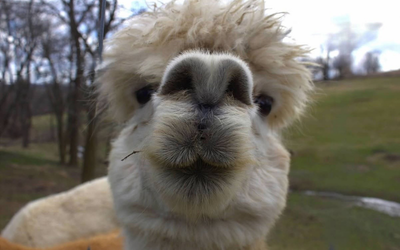
You see a fluffy face, long neck and four legs staring back at you. Is it an alpaca? A llama? And wait—where do vicuñas and guanacos fit into the picture?
If you’ve ever had trouble telling these animals apart, you’re definitely not alone!
Alpacas and llamas are closely related, but they have some pretty noticeable differences once you know what to look for. They’re also part of a much bigger animal family with a fascinating history that stretches all the way to South America.
At The Crafty Alpaca in Avella, Pennsylvania, we love giving visitors the opportunity to do more than read about these animals. A visit to our alpaca farm and Education Center lets you get an up-close look at alpacas, learn about fiber animals and discover what life on the farm is really like.
First Things First: Are Alpacas and Llamas Related?
Yes! Alpacas and llamas are both members of the camelid family, which means they’re actually relatives of camels.
The camelid family includes the familiar dromedary and Bactrian camels as well as four South American camelids: alpacas, llamas, vicuñas and guanacos. Alpacas and llamas have been domesticated for thousands of years, while vicuñas and guanacos remain wild animals.
So while an alpaca might not look much like the camel you picture wandering through the desert, they’re part of the same extended family!
What’s the Difference Between an Alpaca and a Llama?
One of the easiest ways to tell an alpaca from a llama is by size.
Llamas are considerably larger than alpacas. The Crafty Alpaca’s educational information notes that adult alpacas generally weigh between about 100 and 200 pounds, while llamas can weigh roughly 250 to 450 pounds.
Their ears can give you another clue. Alpacas tend to have shorter, straighter ears, while llamas are known for their longer, banana-shaped ears. Once you learn to spot the difference, telling the two apart becomes much easier.
Historically, the animals have also served different purposes. Llamas have commonly been used for packing and guarding livestock, while alpacas have primarily been raised for their beautiful fleece.
And that fleece is a big part of what makes alpacas so special.
What Makes Alpaca Fiber Unique?
Alpacas are typically sheared once a year, and their fleece can be processed and spun into yarn. That fiber can then become everything from socks, hats and scarves to sweaters, blankets and other handcrafted goods.
There are also two main types of alpacas: Huacaya and Suri. Huacaya alpacas have the fluffy, crimpy fleece that creates the teddy-bear appearance many people associate with alpacas. Suri alpacas have long, silky fleece that falls in distinctive locks.
Learning how fleece becomes fiber—and eventually something you can wear or use—is one of the reasons a visit to an alpaca farm can be such an interesting experience for both kids and adults.
What About Vicuñas and Guanacos?
Here’s where the family tree gets even more interesting.
Vicuñas and guanacos are wild South American camelids, unlike their domesticated alpaca and llama relatives. The vicuña is particularly closely related to the alpaca and is known for its exceptionally fine fiber.
Together, alpacas, llamas, vicuñas and guanacos are a great example of how animals within the same family can develop different sizes, appearances, behaviors and roles.
And camelids aren’t the only animals that produce useful natural fibers. That’s part of the bigger story visitors can explore at The Crafty Alpaca’s Education Center.
Go Beyond the Alpacas at The Crafty Alpaca Education Center
There’s a big difference between reading about an animal and getting to experience farm life for yourself.
The Crafty Alpaca Education Center in Avella, PA, was created to give visitors a hands-on way to learn about different fiber animals, life on the farm and how natural fibers are used. The farm has specifically welcomed families, homeschoolers, Scout troops and other groups for educational experiences. And yes, there’s plenty of alpaca time, too!
During a visit to The Crafty Alpaca, guests can get up close to the herd, feed alpacas, feel their fleece and learn more about these gentle, inquisitive animals. Visitors can also see a spinning demonstration and explore the Farm Store to see how fiber can make its way from an animal on the farm to a finished product.
That makes the experience part farm visit, part animal encounter and part hands-on lesson — and a fun way to discover just how much there is to learn from the animals around us.
Looking for an Educational Farm Experience Near Pittsburgh?
If you’re searching for an alpaca farm near Pittsburgh, a hands-on educational activity in Washington County, PA, or simply a unique way to spend time together, The Crafty Alpaca offers an experience that’s a little different from your typical day out.
Located at 115 Rea Road in Avella, Pennsylvania, The Crafty Alpaca welcomes visitors by appointment for farm tours and experiences.
Come meet the alpacas you’ve just learned about, discover the world of fiber animals at the Education Center and see what life at The Crafty Alpaca is all about.
After all, it’s much easier to remember the difference between an alpaca and a llama once you’ve met an alpaca face-to-face!
Ready to meet the herd? Book Your Experience at The Crafty Alpaca!